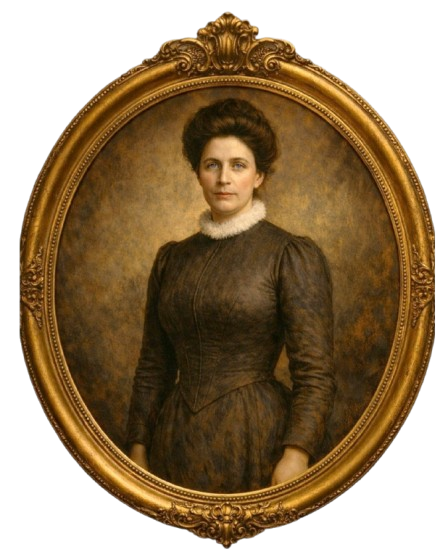
The Mysterious Woman on the Family Wall
It all began with the picture of a mysterious woman hanging on the wall in my grandparents’ home.
My grandparents had a family wall densely covered with photographs. One of the pictures showed a beautiful woman with dark hair piled high on her head, dressed in a long gown with a fur collar.
None of us grandchildren knew who the woman was, but we knew that she was our grandfather’s mother, and therefore our great-grandmother.
My grandfather had grown up with a foster family and did not know his mother.
There was a great deal of mystery surrounding the woman in the photograph, and over the years our speculations and theories became more and more fantastical.
One of them was that our grandfather had been a foundling, and that his mother had placed a picture of herself in his basket, the very picture that was now hanging on the wall.
At that time, church records could only be accessed through personal inquiries to the parishes, and it never occurred to us that we might one day be able to find our great-grandmother.
The Internet and Genealogy
Then came the Internet. In time, church records and other archival materials were digitized, making genealogy research possible for ordinary people.
So when MyHeritage became known in Denmark, I created a profile and hoped, unsuccessfully, to find her that way.
Forsvundne Arvinger and Foundling Records
One day I watched the television program Forsvundne Arvinger, and there I learned that something called a foundling register existed.
Since my grandfather had been born at the Royal Maternity Institution in Copenhagen, I hoped there might be a trace of her there.
Bingo
I found the first concrete clue about the mysterious woman from the photograph on the family wall. In the register stood her name,
Cecilie Olsdotter, along with the date and place of birth she had provided: Sölvesborg in Sweden.
I therefore began searching through the church records from Sölvesborg, but found no Cecilie Olsdotter.
So I took a DNA test and uploaded the results to MyHeritage. Still nothing.
I then taught myself to use various DNA tools, and eventually I succeeded in narrowing down a number of Swedish DNA matches with whom I shared ancestors.
I found my great-grandmother.
Her name was not Cecilie, as she had stated at the Maternity Institution, nor had she been born in Sölvesborg, but in Jämshög.
It took me several years to find my great-grandmother, although of course this was not something I worked on constantly.
Along the way, I also built a large family tree.
The Overlooked Swedish Immigration
Svenborg turned out to have been part of the great Swedish immigration to Denmark that took place in the late nineteenth century.
Thousands of Swedes came to Denmark to work, especially in Copenhagen and on the manors of Zealand, and many left a lasting mark on Danish society.
Even so, this is today a relatively overlooked part of history, known to many mainly through Pelle the Conqueror and the film adaptation of the same name.
The 1875 Aliens Act, “The Swedish Law”
Svenborg had a hard life in Denmark. She was repeatedly expelled under the Aliens Act of 1875, popularly known as “the Swedish Law.” The law allowed authorities to expel foreign citizens who were believed likely to become a financial burden on society, especially if they received, or were at risk of needing, poor relief.
When Svenborg attempted to marry the father of three of her daughters, the parish council formally objected to the marriage because they feared future financial responsibility and poor-relief expenses.
She was subsequently expelled while heavily pregnant.
For unmarried women without property or strong ties to the country, life in Denmark could therefore become highly precarious. Many Swedish women worked as domestic servants, in agriculture, or as factory workers, but they occupied a weak legal position and risked expulsion in cases of illness, unemployment, or pregnancy outside marriage.
A Life Between Two Countries
In 1888, Svenborg was expelled permanently, and after that her continued life in Denmark became an endless struggle with the authorities.
Although Svenborg appears in both Danish censuses and the Copenhagen Police Intelligence Reports, she legally remained attached to Sweden.
In the Swedish household examination records, she is in several places listed as having an unknown place of residence, and some priests added condemning remarks concerning her “moral conduct.”
Svenborg died at Copenhagen Municipal Hospital in 1936 and was buried at Bispebjerg Cemetery.